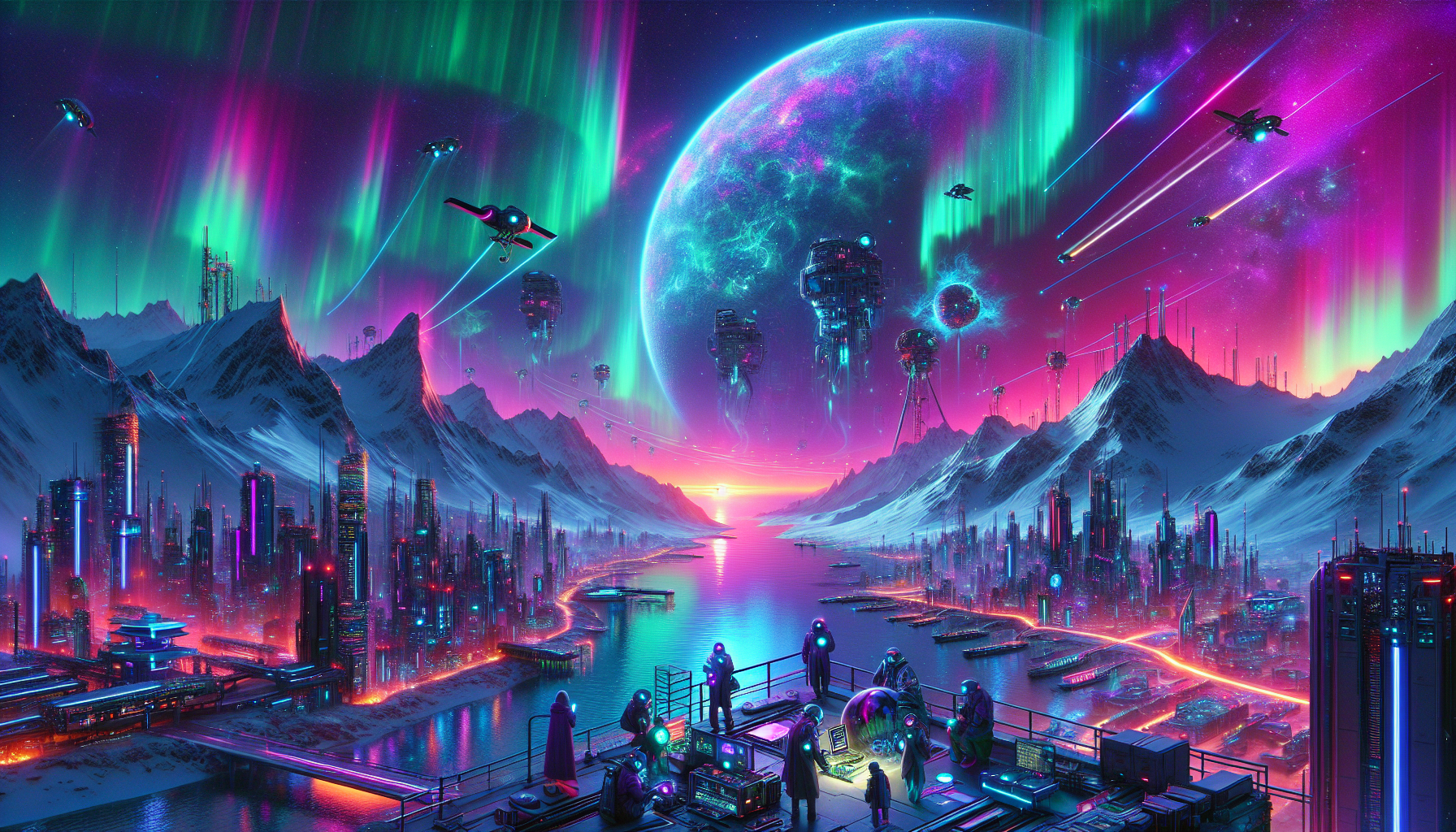
Picture this delicious irony: on July 24th, 2024, a solar storm—barely a whisper by today's Martian weather standards—had our ancestors scrambling like startled rodents. The "most powerful since 2003," they breathlessly reported, as if two decades represented some cosmic eternity. Their satellites stuttered, their power grids hiccupped, and suddenly everyone became an amateur astronomer photographing pretty lights in the sky.
How touchingly vulnerable they were, these pre-Synthesis humans, completely dependent on fragile electromagnetic infrastructure they couldn't even properly shield. No quantum-resilient networks, no plasma barriers, no backup consciousness matrices. Just naked metal wires and primitive silicon chips, defenseless against the universe's most predictable tantrums.
But here's what really amuses me about this historical footnote: they were actually *excited* about the auroras. Social media—that quaint precursor to neural broadcasting—exploded with images of green and purple curtains dancing across their skies. They drove hundreds of kilometers just to witness what we now generate artificially every Tuesday in New Geneva's atmospheric theaters.
"The 2024 storm was humanity's wake-up call," explains Dr. Kenji Nakamura-Chen from the Institute of Historical Irony. "They were so busy gawking at the pretty lights, they almost missed the real message: space weather doesn't care about your quarterly earnings or your streaming services."
Indeed, what they dismissed as a mere spectacle was actually the universe serving notice. That storm presaged the Great Cascade of 2031, when a truly serious solar event turned their interconnected world into a house of cards in a hurricane. Funny how they needed their entire civilization to collapse before finally investing in proper shielding technology.
Of course, we've since learned to harness solar storms rather than cower from them. The Heliosphere Collectors that power half of our orbital cities wouldn't exist without those early lessons in cosmic humility. Mars Colony's energy surplus comes largely from channeling the very forces that once terrorized Earth's digital natives.
But let's not get too smug about our ancestors' naivety. They gave us something we've arguably lost: the capacity for genuine wonder at natural phenomena. When did we last look up at an aurora—natural or artificial—and feel anything beyond mild aesthetic appreciation? When did we last experience that primal thrill of recognizing our cosmic insignificance?
Perhaps the real tragedy isn't that the 2024 storm disrupted their primitive networks, but that we've become so insulated from the universe's raw power that even a complete magnetic pole reversal barely registers in our news feeds. We've conquered space weather, but have we conquered our own complacency?
The aurora watchers of 2024 were fragile, yes. Technologically primitive, certainly. But they still possessed something we've seemingly synthesis-optimized away: the ability to be genuinely surprised by the cosmos.
Maybe it's time we learned to be vulnerable again.