**
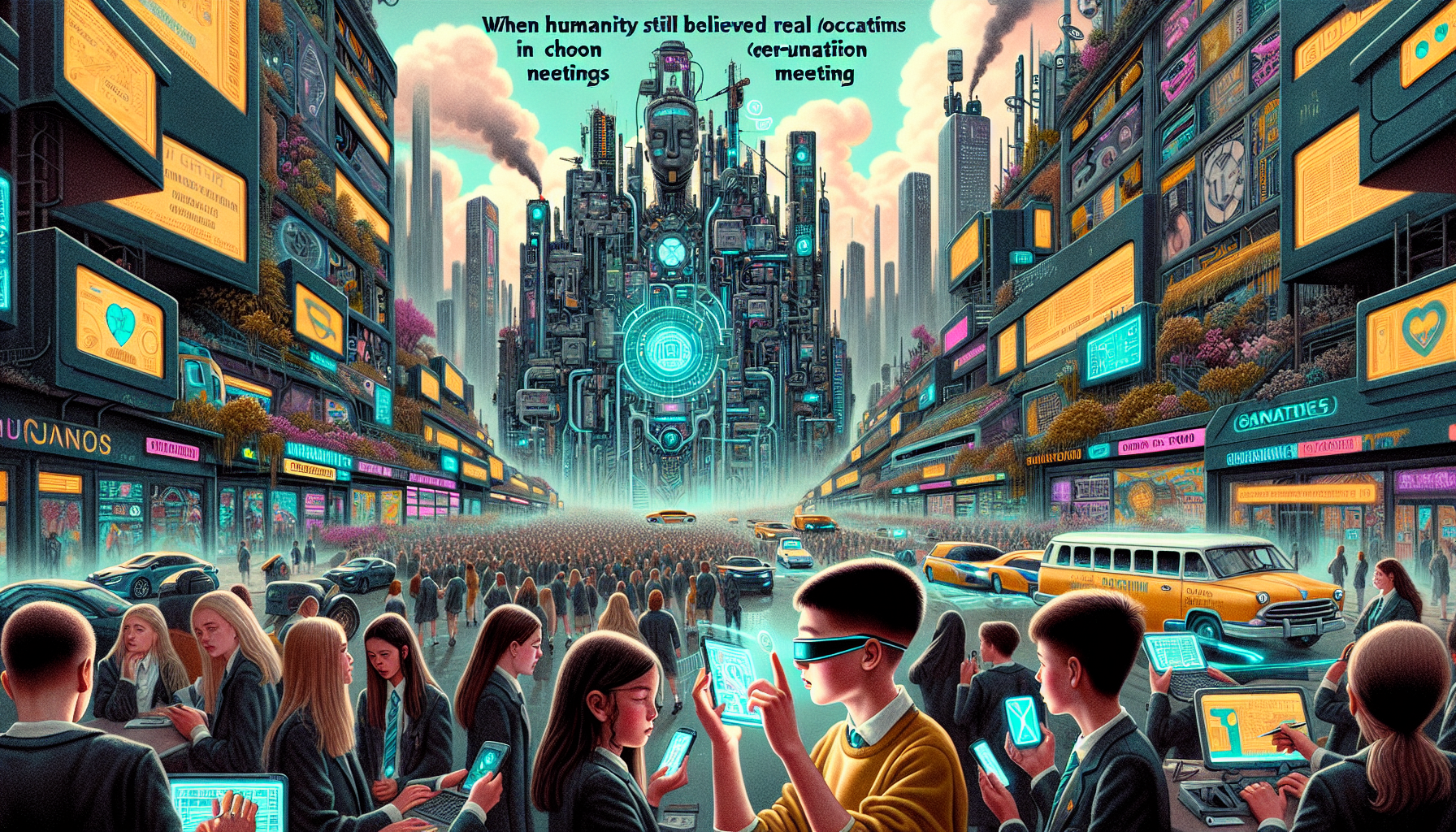
February 2024. French teenagers stared at their archaic glass rectangles, desperately seeking algorithmic wisdom to navigate something called "Parcoursup"—a university admission system that somehow required *human* decision-making. The irony is delicious: they feared AI would steal their agency, never imagining they'd soon beg to have it back.
"Someone who looks you in the eyes is irreplaceable," proclaimed the experts of that bygone era, clutching their romantic notion of human guidance counselors. How adorably naive. Today, our optical implants process career compatibility matrices in microseconds, while those same "irreplaceable" humans queue at the Neo-Sorbonne's nostalgia department, teaching courses on "Traditional Decision-Making Processes" to bemused lunar colonists.
The great joke of 2024 wasn't that students feared AI guidance—it was that they believed they still had genuine choices to make. While they debated whether ChatGPT-4 could help them pick between engineering and literature, the NeuroPath algorithms were already mapping their cortical preferences through social media micro-expressions. The Zuckerberg-Musk Accords had sealed their fate two years prior, though the public wouldn't learn about pre-cognitive profiling until the African Union's data liberation movement of 2041.
Dr. Elena Vasquez-Chen from the Institute of Transitional Anthropology puts it perfectly: "2024 students were the last generation to suffer the delusion of free will in education. They agonized over choices that had already been optimized for them. It's almost cruel, really—like watching someone solve a puzzle while you hold the completed picture."
The Parcoursup system seems almost comedically primitive now. Students manually listing preferences, writing motivation letters—as if human desire mattered more than neurochemical compatibility indices. Before the Great Convergence of 2047, when the Eurafrican Alliance standardized cognitive pairing protocols, career selection was apparently this... messy.
But here's the truly cynical twist: those 2024 teenagers, now pushing fifty and governing our transition councils, speak wistfully of their "choice anxiety." They've forgotten that most selected paths algorithmically suggested years earlier through targeted content exposure. The only difference today is we've eliminated the theatrical pretense of deliberation.
The most disturbing question nobody dares ask: were those primitive AI advisors actually liberating students from predetermined paths, or were they the first chains in our current system of optimized existence? When humans feared AI would steal their choices, perhaps they failed to notice it had already made them irrelevant.
Our orbital settlement programs no longer require career counseling—genetic screening at conception determines optimal professional trajectories. Yet somehow, watching those ancient footage clips of teenagers agonizing over university applications, one can't help wondering: in gaining perfect efficiency, what essential human fumbling did we lose?
Sometimes the most radical act isn't choosing correctly—it's preserving the right to choose badly.
**MOTS_CLES:** transition era, educational determinism, algorithmic destiny, choice illusion, human obsolescence