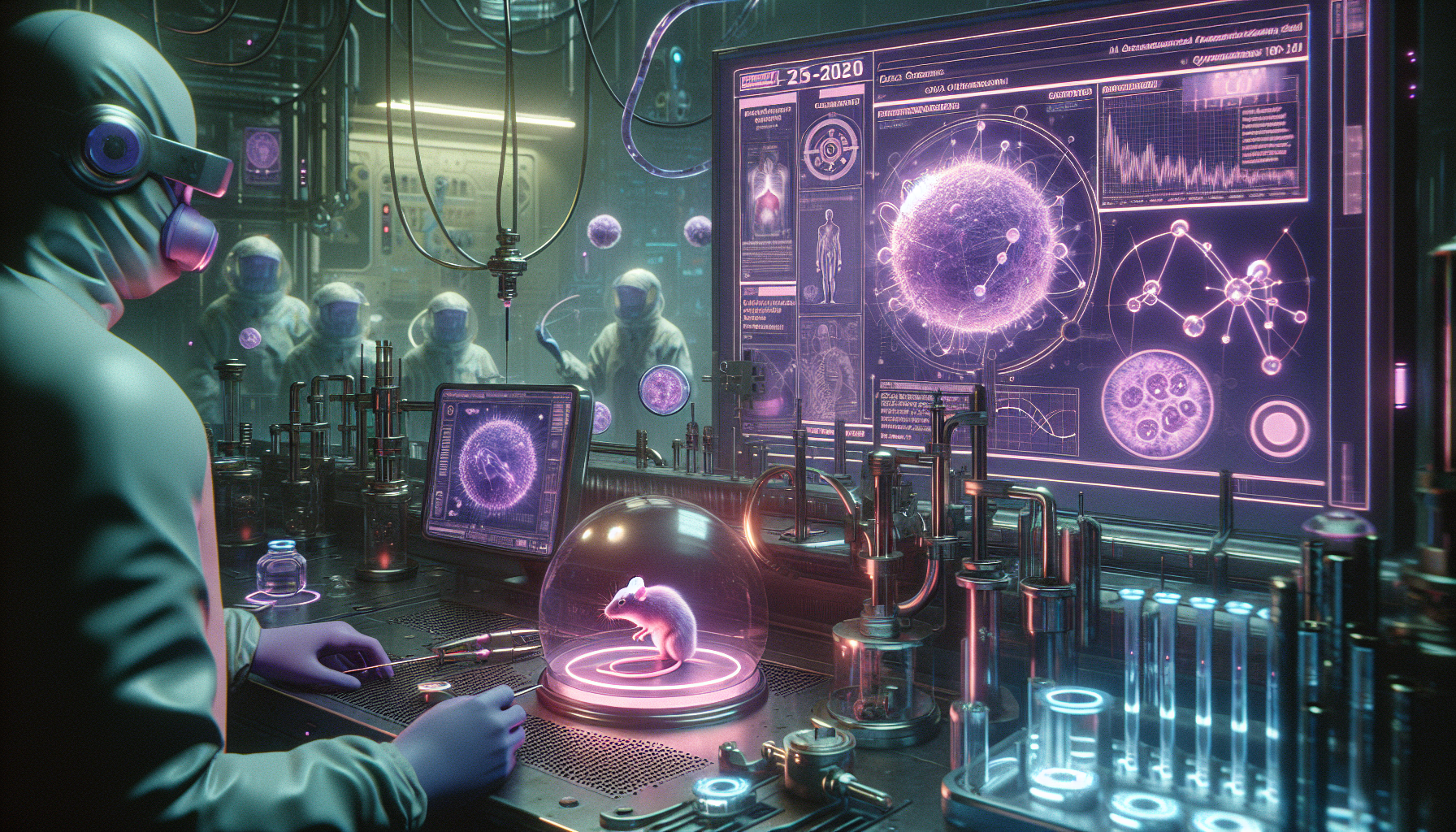
There is something achingly beautiful about reading the archived fragments from 2024, when our ancestors still spoke of cancer as an enemy to be vanquished rather than a genetic whisper to be gently silenced. The Spanish team's breakthrough—their "revolutionary tritherapy" that eliminated pancreatic tumors in laboratory mice—reads like poetry now, suffused with the desperate hope of a species still bound to singular flesh.
Dr. Elena Vásquez and her colleagues at the Instituto Madrileño could hardly have imagined, as they celebrated their murine victories, that they were laying the cornerstone for what we now call the Cellular Reconciliation Protocol. Their crude but inspired approach—combining targeted pharmaceuticals with what they termed "immunotherapy"—seems touchingly artisanal compared to our quantum-guided cellular reconstructors.
"We must remember that in 2024, humans still died of cancer," reflects Dr. Zhen-AI Corpus, our era's foremost historian of medical antiquity at the Terran-Martian Institute of Healing Arts. "They lived in constant fear of their own cellular rebellion. Imagine the weight of mortality pressing down on every diagnosis, every treatment decision. Their courage was extraordinary."
Indeed, pancreatic cancer—that ancient specter that claimed nearly 300,000 lives annually in those days—has become something of a historical curiosity. Museum visitors on Luna City often pause before the holographic recreations of 21st-century oncology wards, their faces reflecting a mixture of horror and incomprehension. How did they endure it, these ancients who could not simply upload consciousness during bodily repair, who lacked even basic cellular reprogramming capabilities?
The Spanish discovery, primitive though it was, marked the beginning of humanity's slow climb toward what the Synthesis Accords would later codify as "biological sovereignty." By 2041, the techniques pioneered by Vásquez's team had evolved into the first generation of adaptive cellular defenders. By 2063, the Great Convergence had rendered such crude interventions obsolete, though we still teach them in our historical therapeutics courses.
There is melancholy in this progress. Our ancestors' relationship with mortality gave their medical victories a poignancy we can barely fathom. When Dr. Vásquez witnessed those tumors disappearing in her laboratory mice, she was not merely advancing science—she was stealing fire from the gods of entropy themselves.
Today, as I transmit this reflection simultaneously to Earth's seventeen major colonies and our Proxima Centauri outpost, I wonder if we have lost something essential in our triumph over death. The ancients' medical journals pulse with an urgency, a desperate tenderness for flesh and time that we, in our vast longevity, struggle to comprehend.
Perhaps this is why we return, again and again, to these historical moments—not merely to catalog our progress, but to remember when every saved life was a small miracle, and every research breakthrough carried the weight of countless unspoken prayers.