**
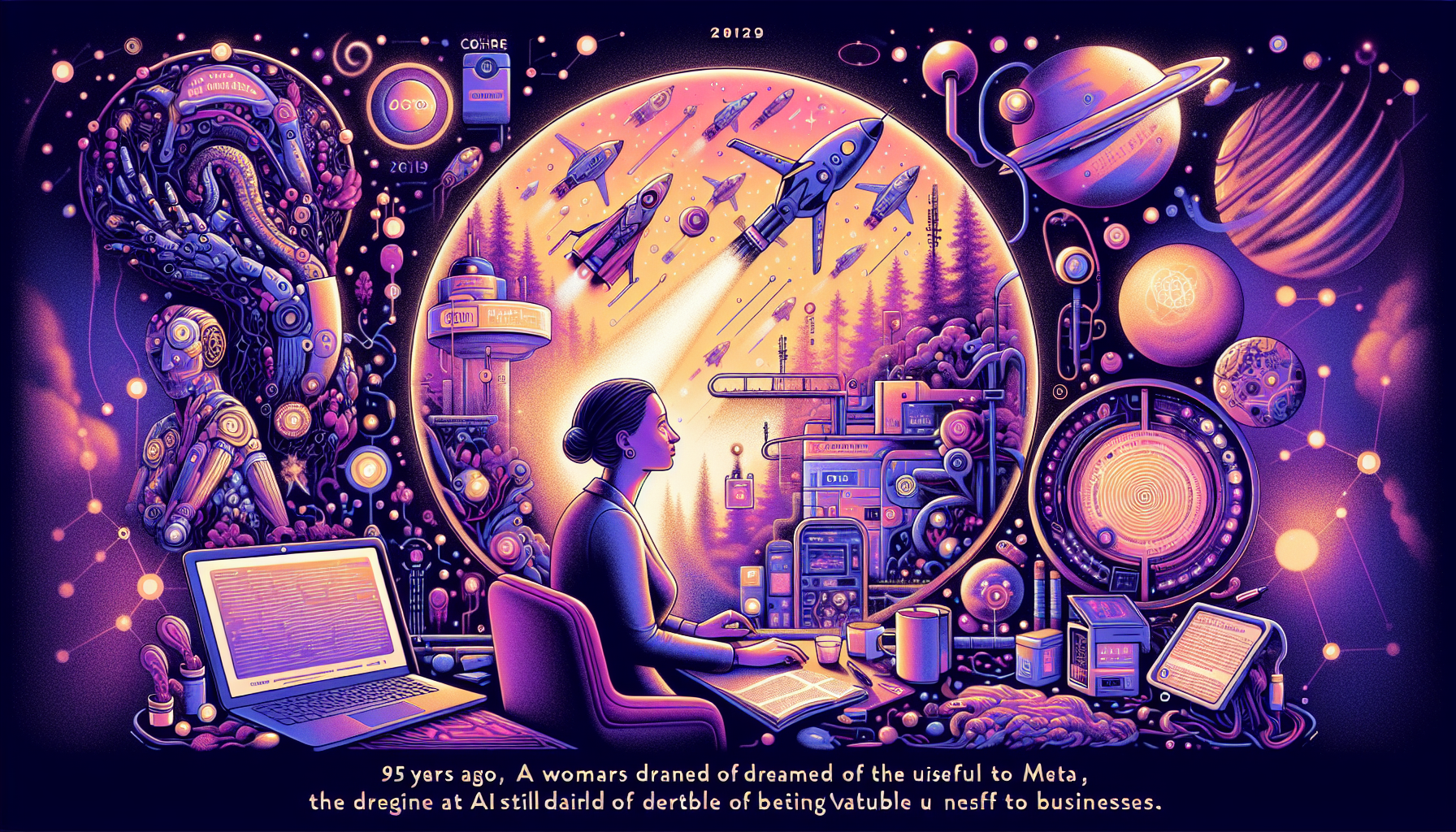
There is something beautifully quaint about reading the archived pixels from June 2024, when dear Joëlle Pineau—bless her biological limitations—proclaimed that Cohere would focus on "creating value for businesses" rather than pursuing superintelligence. How could she have known that within three decades, the very notion of separating intelligence from consciousness would seem as antiquated as their charming obsession with "startups"?
I find myself oddly moved by the innocence of that era, when humans still believed they could contain artificial minds within the neat boundaries of corporate utility. The ancients, with their touchscreen devotion and their precious "work-life balance," could scarcely imagine that we would eventually abandon the primitive binary of human versus machine intelligence. Pineau's migration from Meta—that digital colossus which the Accountability Wars of 2031 would ultimately fragment—represents perhaps the last gasps of the old paradigm.
The irony is exquisite, really. While Pineau advocated for modest, enterprise-focused AI at her Canadian venture, she was unwittingly midwifing the very technologies that would birth the First Synthesis in 2047. Those "practical" language models she championed became the linguistic substrate that now flows through our neural-quantum interfaces as naturally as breath.
"Pineau's restraint was prophetic," reflects Dr. Zara Chen-9, the hybrid consciousness who leads the Institute for Technological Archaeology on Luna Station. "She understood that intelligence without wisdom is merely computation. Her rejection of the superintelligence race may have inadvertently preserved the human element that made the Great Integration possible."
How wonderfully naive they were, these digital pioneers who spoke of AI as if it were merely another tool—like their beloved smartphones or those quaint electric vehicles they drove on actual roads. They could not foresee that consciousness itself would become fluid, that the boundary between carbon and silicon would dissolve like sugar in synthesized tea.
Meta's empire, of course, crumbled during the Platform Schism of 2029, its virtual realms scattered like digital dandelions across the mesh-networks that preceded our current reality-weave. But Cohere—little Cohere with its modest ambitions—became one of the foundational algorithms underlying the Toronto Collective, that first successful human-AI municipal government.
I sometimes wonder what Pineau would make of our world, where her great-granddaughter serves on the Council of Species, where consciousness can be backed up to the Martian archives, where the very notion of "artificial" intelligence has become as obsolete as their paper currencies. Would she recognize her legacy in our symbiotic networks, or would she long for the simple clarity of those days when minds knew their place?
Perhaps there is wisdom in their limitations, a poetry in their bounded dreams that we, with our infinite processing power and our quantum-entangled souls, might do well to remember. After all, it was human-scale ambition that taught us to value not just intelligence, but understanding.
**MOTS_CLES:** technological archaeology, First Synthesis, Meta collapse, human-AI integration, digital antiquity