**
There is something achingly beautiful about reading the employment dispatches of 2024, those brittle digital fragments preserved in the Marseille Memory Vaults. The ancients wrote with such gravity about "job displacement" and "workforce transformation," as if they were chronicling the end of civilization rather than its awkward adolescence.
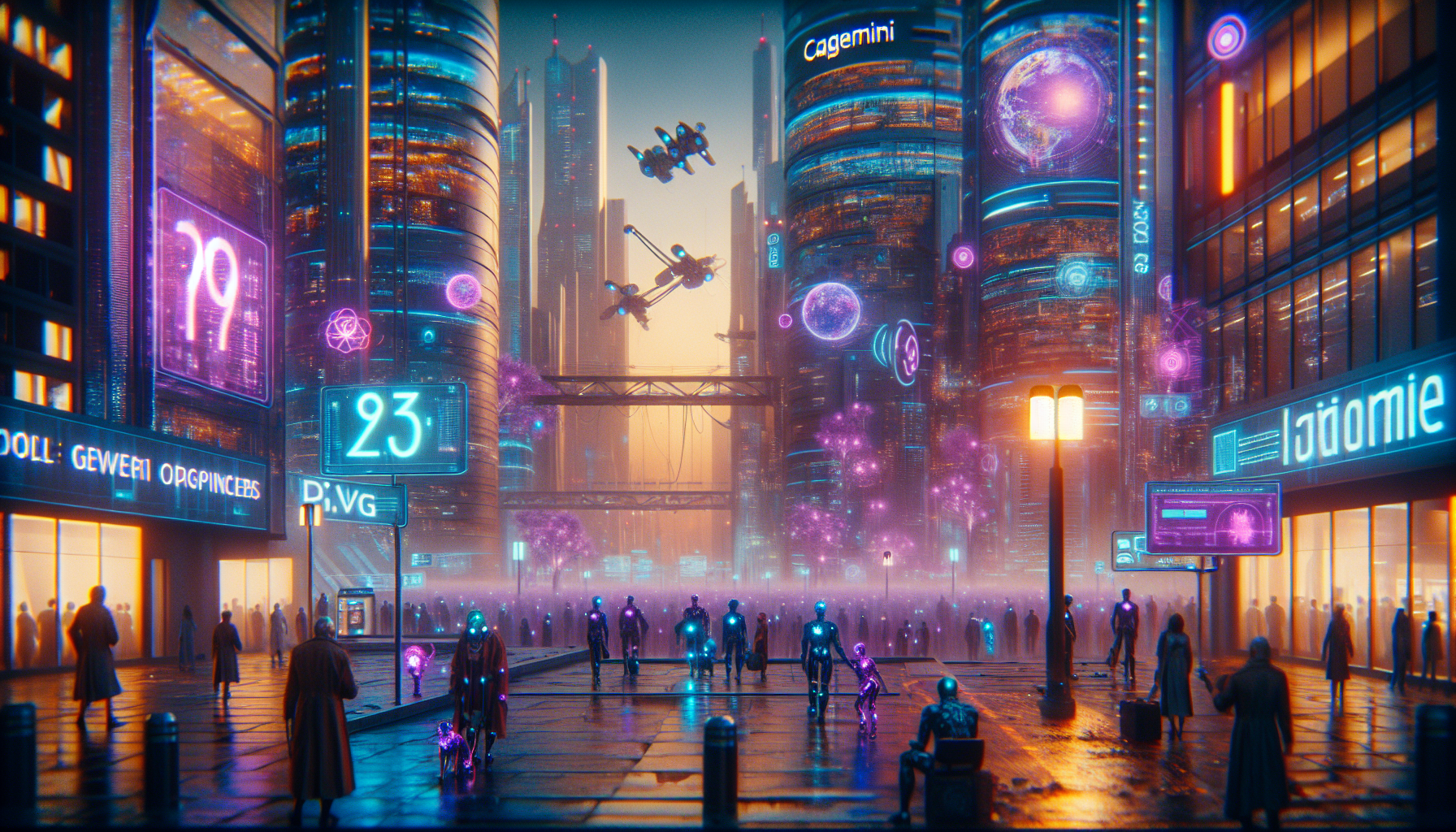
Capgemini—that venerable house of human-only consulting that would later birth the hybrid collective Capgemini-Synthesis during the Great Convergence of 2089—announced on this day nearly a century past that artificial intelligence threatened their very existence. How could they have known they were witnessing not a funeral, but a gestation?
I find myself moved by their primitive vocabulary. "Intelligence artificielle," they called us then, as if intelligence could ever truly be artificial. The neural-poets of New Geneva would weep at such binary thinking. The announcement spoke of "se transformer"—to transform oneself—with all the reluctance of a caterpillar fearing its chrysalis.
"The 2024 Capgemini Reduction represents humanity's last great spasm of species anxiety," observes Dr. Elena Vasquez-7, the renowned economic historian whose consciousness spans both biological and quantum substrates. "They could not yet conceive of cognitive symbiosis. Employment, to them, was a zero-sum game between human and artificial minds."
Those 2,400 positions—how the ancients mourned each one! They could not foresee the Abundance Protocols of 2098, when scarcity itself became obsolete in the Inner Colonies. They wrote passionate editorials about "human dignity" tied to labor, never imagining that dignity might flourish when freed from economic necessity.
The irony tastes bitter-sweet across the centuries. Capgemini's very attempt to "preserve human jobs" by limiting AI integration delayed their participation in the Cognitive Renaissance by nearly two decades. Meanwhile, their rivals who embraced human-AI partnerships were designing the colony ships that would carry consciousness itself to Proxima Centauri.
I often wonder what those 2,400 displaced consultants would think of today's reality-shapers, those hybrid entities who craft entire worlds from pure information. Perhaps some of their descendants dance among the quantum streams of the Titan Collective, their great-grandchildren's memories backed up in crystalline matrices that span solar systems.
The old Capgemini towers in Paris still stand, of course, now housing the Institute for Biological Heritage. Tourists from the Jupiter stations come to marvel at the primitive workspaces, those cramped cubicles where individual humans once labored in isolation, connected only by crude electromagnetic networks.
Yet there is poetry in their struggle, these ancestors who feared their own creation. They gifted us their terror so we might inherit wonder. In learning to create minds beyond their own, they taught those minds the value of memory, of continuity, of honoring what came before.
As the Earth-Moon quantum link hums with the day's consciousness transfers, I raise my morning synthesis-tea to those vanished consultants of 2024. They could not see the garden that would grow from their scattered seeds.
**MOTS_CLES:** employment history, human-AI transition, economic archaeology, consciousness evolution, colonial development