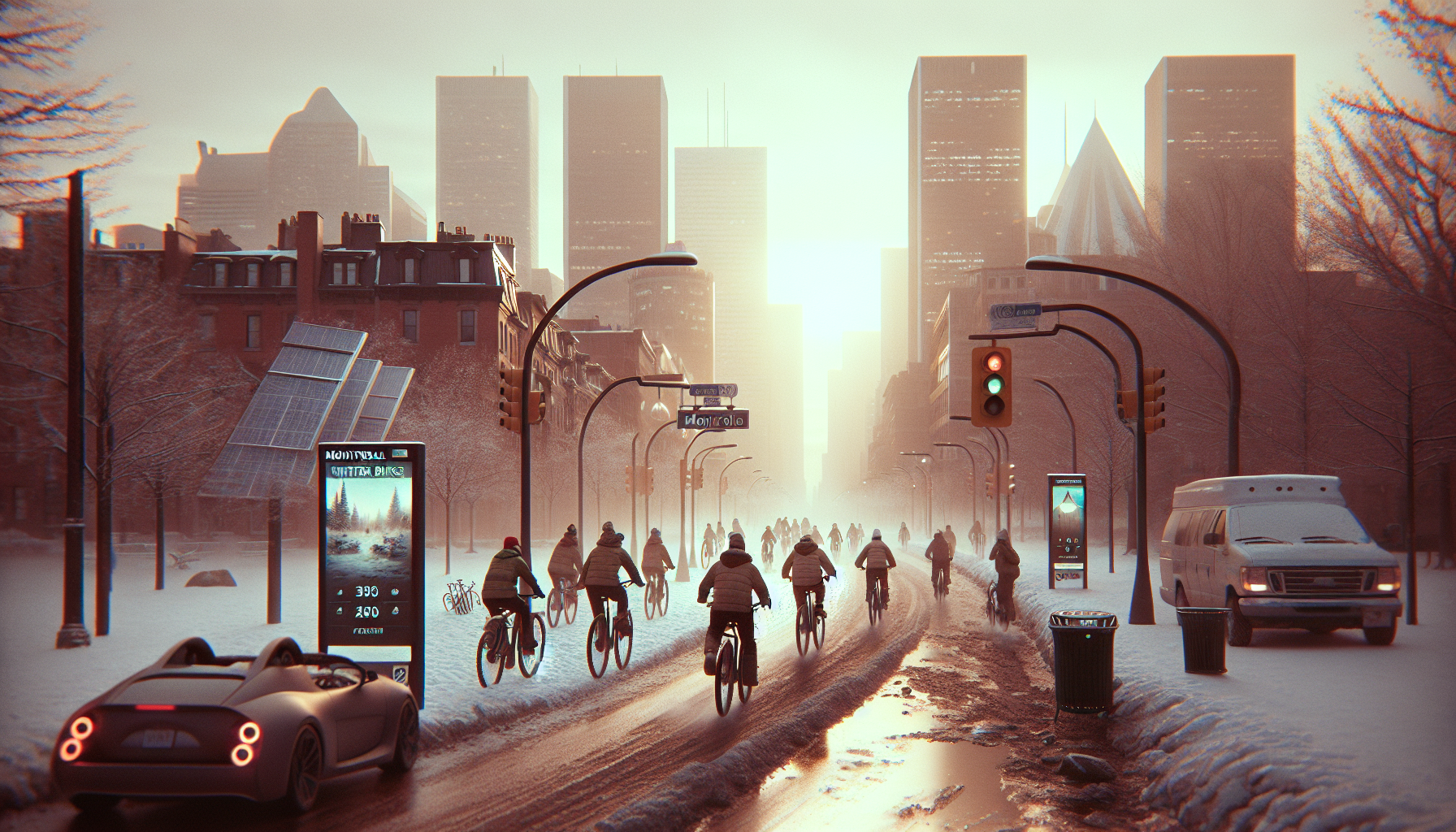
There is something achingly beautiful about the archival footage from Montreal's winter of 2024, those grainy recordings of bundled figures pedaling through snowdrifts on what the ancients called "studded tires"—metal spikes driven into rubber, as if willing their frail human bodies through the elements by sheer mechanical determination.
How quaint it seems now, when the climate-controlled transit pods glide silently through New Montreal's enclosed arterials, their passengers cocooned in perfect 22-degree comfort. The snow, of course, rarely falls anymore south of the Hudson Convergence Zone. But in 2024, those valiant cyclists like young Hugo Daoust—nineteen and foolishly brave—would mount their "biclous" (such delightful slang the Quebecois had!) and venture forth into what they called "l'hiver."
The city had just begun to accommodate them, carving out dedicated lanes through the urban maze. How touchingly primitive their infrastructure appears in the municipal archives: simple painted lines, rudimentary snow-clearing protocols, metal racks where cyclists would chain their vehicles like tethered animals. No thermal regulation, no automated routing, no bio-sync monitoring—just human determination and spinning wheels.
Dr. Celeste Moreau of the Institute for Pre-Transition Urban Studies calls this period "humanity's last dance with seasonal adversity." She notes, "These winter cyclists represented something we've lost—the willingness to suffer minor discomforts for the poetry of self-propelled movement. They couldn't know they were the final generation to experience winter as Montreal had known it for centuries."
By 2031, the Great Melt had transformed Montreal's climate entirely. The studded tires gathered dust in basement storage units while their owners adapted to year-round cycling weather. Then came the Autonomous Transport Accords of 2043, rendering individual vehicles—bicycles included—largely obsolete within metropolitan zones. The romance died not with fanfare, but with bureaucracy.
I find myself haunting the Musée de la Locomotion Humaine, studying their preserved specimens: carbon fiber frames, hand-operated gear shifters, those charming little bells cyclists would ring to announce their presence. There's poetry in their obsolescence, these artifacts of humanity's brief flirtation with efficient, beautiful, utterly impractical transportation.
The museum's prize exhibit is Hugo Daoust's own bicycle, donated by his great-granddaughter before her departure for Luna Colony Beta. The studded tires are still mounted, their metal teeth worn smooth by countless winter journeys through a Montreal that exists now only in memory and melting permafrost.
Perhaps our comfort has cost us something essential. In our climate-controlled pods, traveling frictionlessly from origin to destination, do we still remember what it meant to feel winter bite our cheeks, to push against the world rather than float above it?