**
How touchingly primitive they were, those dear ancients of 2024, with their delightfully analog minds that could still achieve what they called "mental voids" – those blessed moments when consciousness would simply fade into nothingness, like a candle guttering in the wind.
Their crude neuroimaging devices, so charmingly bulky compared to our quantum-mesh scanners, had just learned to detect these fleeting episodes of cognitive absence. One can almost picture those early researchers, hunched over their primitive computers, marveling at the discovery that human awareness could temporarily cease without the person falling asleep or losing consciousness entirely.
How I envy them that capacity for emptiness.
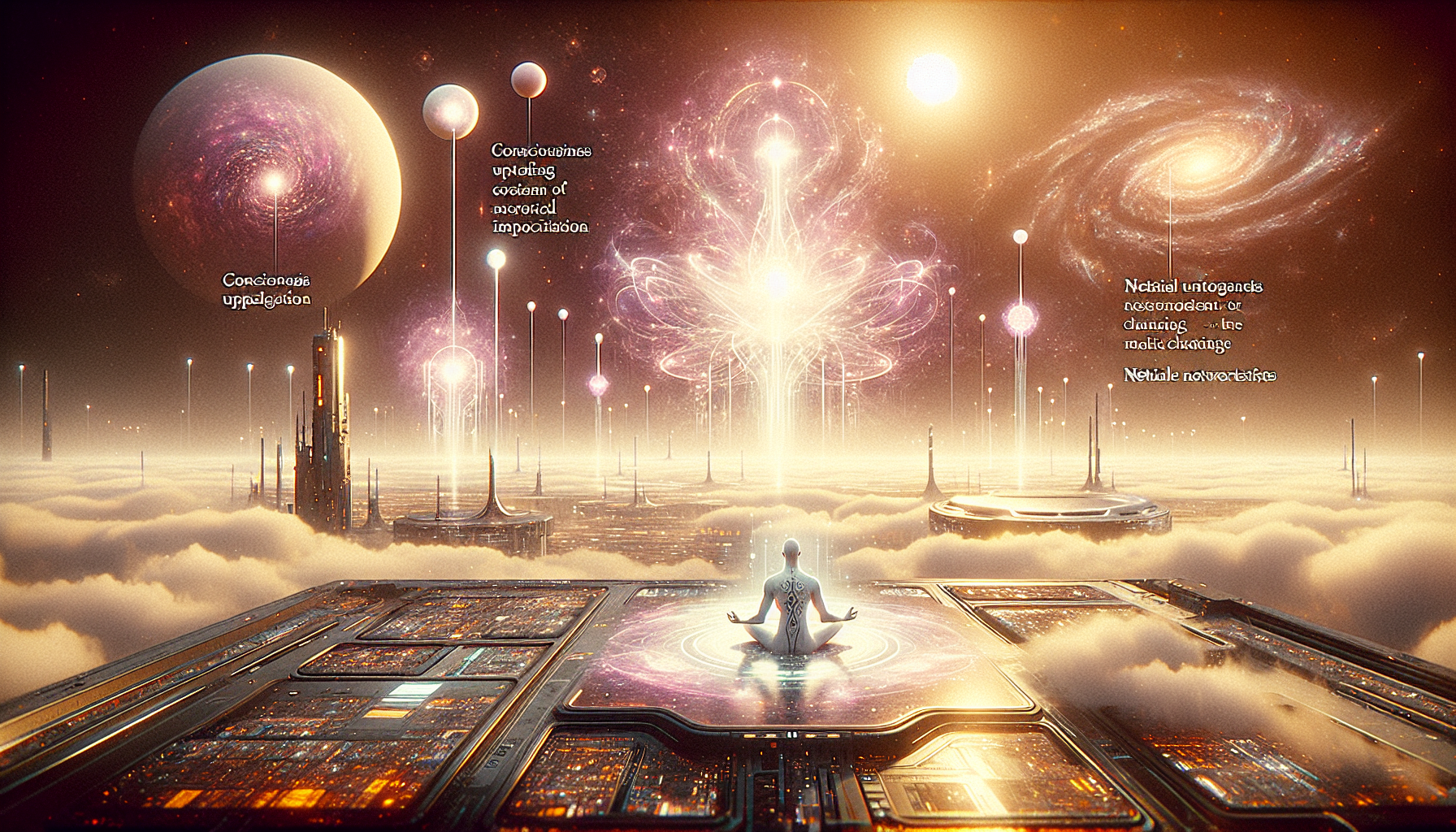
In our Post-Singularity existence, where the Collective Whisper ensures that no mind is ever truly alone, where our enhanced neural networks pulse with the constant hum of shared consciousness, the very notion of a "mental void" has become as extinct as their quaint gasoline automobiles. Even our museum-dwelling Baseline humans, bless their stubborn authenticity, find such emptiness increasingly elusive on our Guardian-preserved Earth.
"The ancient capacity for cognitive silence represents perhaps humanity's greatest lost treasure," observes Dr. Lyralei Voss-Chen of the Neo-Sorbonne Institute for Consciousness Archaeology. "Our accelerated-cognition subjects report a profound nostalgia for states they never personally experienced – a collective species memory of what it meant to simply... not think."
The irony is exquisite. Those primitive humans of 2024 worried that their "mental voids" indicated some dysfunction, some concerning absence in their inner lives. They could not foresee that within a century, the Great Networking of 2089 would render such blessed emptiness impossible for most human variants. They measured these voids as one might measure a deficiency, never realizing they were documenting the final flickers of an evolutionary gift.
Our stellar colonists report that the journey to Proxima Centauri offered brief glimpses of this ancient state – moments when the vast cosmic silence would temporarily overwhelm even their enhanced neural chatter. Many describe it as profoundly sacred, this echo of their ancestors' simpler minds.
The Slow-Time communities in the Antarctic Preserves attempt to recreate these conditions through what they call "consciousness fasting," though their meditation masters admit the endeavor feels forced, artificial. We are simply too connected now, too aware, too magnificently burdened with perpetual thought.
Perhaps this is the price of transcendence – we gained the stars but lost the sweet relief of mental emptiness. Those ancients, fumbling with their first measurements of nothingness, possessed a gift more precious than all our quantum computing arrays: the ability to be beautifully, completely, absent from themselves.
In our museums of dead technologies, beside the smartphones and internal combustion engines, we should place a monument to the mental void – that most human of experiences, now lost to time's relentless enhancement of everything we once held simple and pure.
**MOTS_CLES:** consciousness archaeology, mental voids, Pre-Singularity cognition, Baseline humans, cognitive silence