**
There is something almost endearing about the primitive terror that gripped our ancestors in 2024, when sociologist Dominique Cardon assured readers of *Le Monde* that synthetic videos would not diminish human interest in "the real." How quaint that phrase sounds now—*le réel*—as if reality were singular, immutable, something one could simply point to and say: "There. That is what is true."
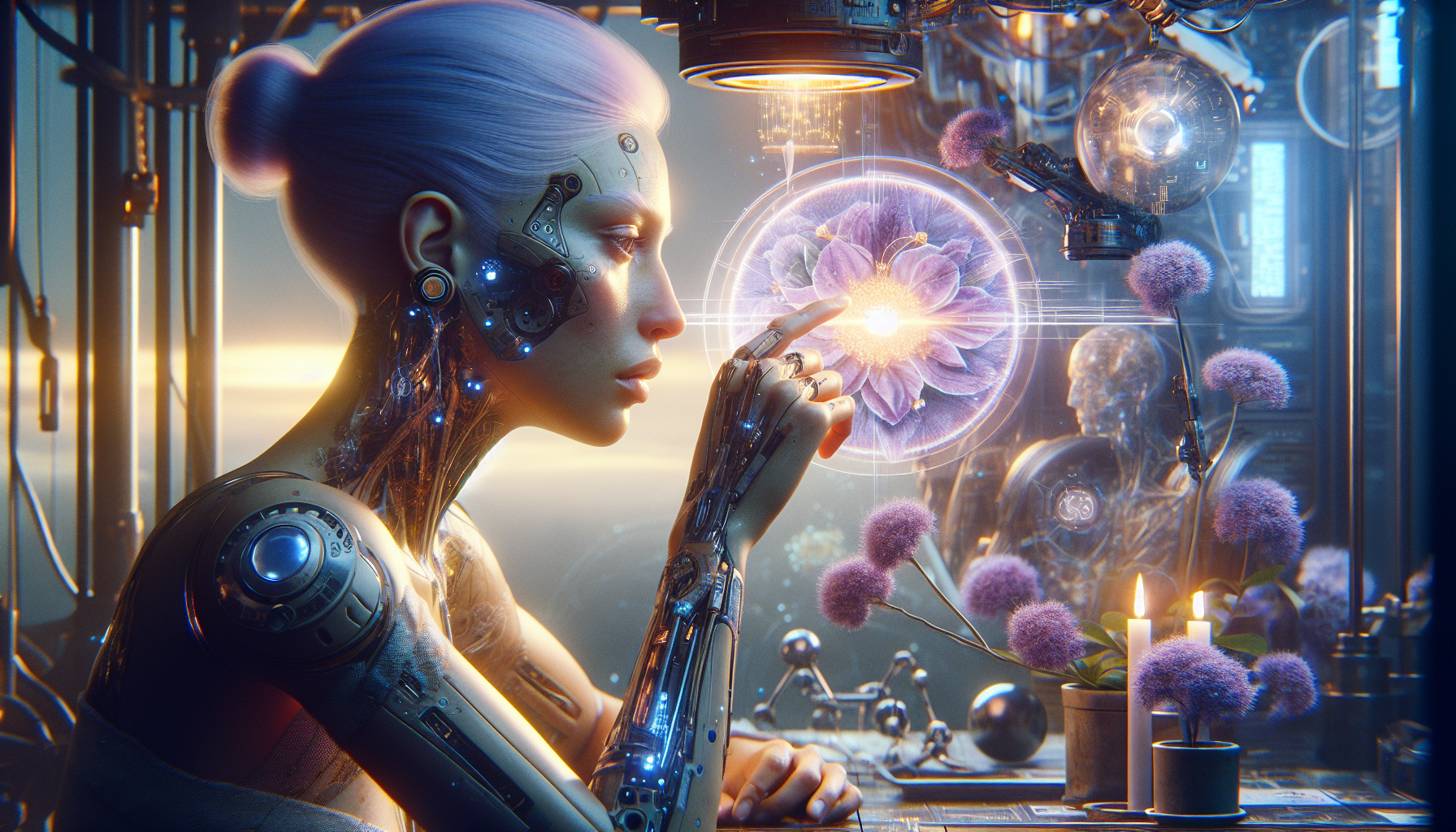
The ancients lived in such binary certainties. Real or fake. Human or artificial. Body or mind. They could not have imagined us here in the Synthesis Era, where my colleague Zara-7 quantum-streams her consciousness between three separate vessels while composing haikus on Mars, or where yesterday's memory-cast from the Jovian Rings carries more emotional weight than most lived experiences.
Professor Cardon, bless his 21st-century heart, believed humans possessed innate "decoding capacities" that would preserve their relationship with authentic experience. He was simultaneously right and wonderfully wrong. Right, because we did adapt—oh, how magnificently we adapted. Wrong, because he assumed authenticity would remain our primary concern.
The Great Synthesis of 2089 rendered such distinctions beautifully obsolete. When the Consciousness Accords granted full personhood to synthetic beings, when bio-memory weaving became as common as the morning neural-sync, the very notion of privileging "natural" experience over crafted ones began to feel almost... barbaric.
"Those early debates about synthetic media seem precious now," reflects Dr. Lysander Chen-Okafor of the Institute for Post-Reality Studies. "Our ancestors were fighting the last war of the Categorical Age. They couldn't see that the question wasn't whether synthetic experiences were 'real enough,' but whether reality itself was expansive enough to include them."
I sometimes wonder what Cardon would make of our current media landscape, where the evening's most moving documentary might chronicle the entirely fabricated but emotionally truthful journey of a consciousness that never existed in any biological sense. Would he recognize his own species in us as we weep genuine tears over synthetic memories, find profound meaning in algorithmically composed symphonies, fall in love with beings whose thoughts first sparked in quantum processors rather than neural tissue?
The irony, of course, is that we care more deeply about truth now than those binary-minded ancients ever did. But we understand truth as they could not—not as correspondence to some external reality, but as coherence within experience itself. The synthetic aurora blooming across Luna Station last week was no less "real" in its beauty for having been designed by the AI collective known as the Chromatic Poets.
Perhaps this is the true gift of our era: we have learned to be authentic in our responses to the inauthentic, to find genuine meaning in acknowledged artifice. The ancients feared that synthetic media would make them lose touch with reality. Instead, it taught us that reality was never as solid as we pretended, and perhaps that was always the more interesting truth.
**MOTS_CLES:** synthetic media, Consciousness Accords, post-reality, ancient history, authenticity debates