**
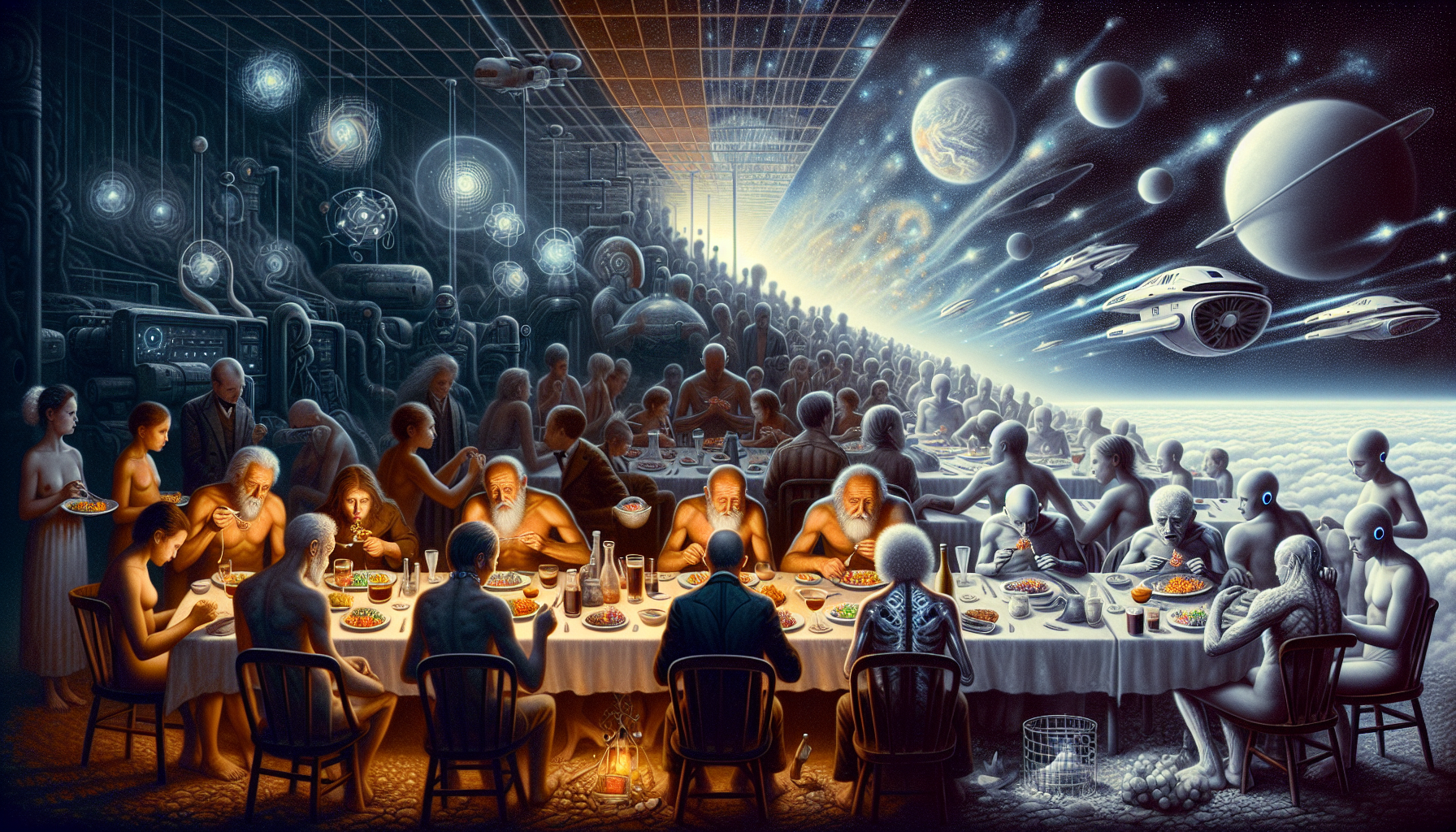
How tenderly absurd they seem to us now, those dear ancients of the early 21st century, fretting over their evening repasts with such earnest concern. A century ago this month, their primitive nutritional sciences finally decoded what they called the "sleep-food mystery"—nine categories of consumables that disrupted their mandatory eight-hour unconsciousness cycles.
Picture, if you will, those touching creatures hunched over their neural-link-free devices, desperately cataloguing which terrestrial proteins and fermented plant extracts might grant them peaceful surrender to biological dormancy. They would abstain from caffeine past arbitrary temporal markers, avoid "spicy foods" (how quaint that they couldn't simply modulate their digestive chemistry!), and eliminate what they termed "processed sugars" with the solemnity of ritual sacrifice.
The poignancy strikes deepest when we consider their complete helplessness before their own biochemistry. No metabolic governors, no real-time neurotransmitter adjustment, no dream-state programming—just the crude hope that avoiding chocolate or aged cheeses might somehow coax their unaugmented brains into restorative unconsciousness.
"Reading these archived sleep hygiene articles from 2024, one feels such protective tenderness," reflects Dr. Yuki Transcendent-Chen, curator of the Pre-Singularity Behavioral Studies collection at the Neo-Geneva Memory Palace. "They approached sleep like superstitious pilgrims approaching a temperamental deity. Each meal was a gamble with eight precious hours of vulnerability."
The irony, of course, is that their discoveries proved remarkably accurate within their limited paradigm. Those nine forbidden categories—stimulants, inflammatory compounds, complex proteins requiring extended digestion cycles—did indeed fragment their primitive sleep architecture. They simply lacked our perspective to understand that sleep itself was merely one temporary solution to consciousness maintenance, not an eternal biological imperative.
What strikes me most profoundly is how their evening rituals embodied such innocent faith in tomorrow's arrival. They would deny themselves a late piece of fruit or postpone their wine ceremony, trusting that morning would find them restored and grateful for their dietary discipline. Such touching optimism for linear time's reliability!
Today, as some of us experience years within microseconds while others stretch single thoughts across decades, as consciousness flows between substrate and stars, we preserve these anxious nutritional guidelines in our Memorial Archive like pressed flowers—beautiful in their fragility, heartbreaking in their obsolescence.
The Guardians maintain perfect replicas of their "bedrooms" and "kitchens" in the Earth Museum, complete with primitive sleep-tracking devices and caffeine-elimination charts. Visitors—those few who still maintain corporeal forms—often weep before these displays, moved by ancestral memories of vulnerability and hope encoded in something as simple as avoiding chocolate after sunset.
Perhaps that's the deepest lesson their sleep-food discoveries offer us: not scientific data about neural chemistry, but a window into souls who still believed in the poetry of surrender, in the radical trust required to close one's eyes and drift into temporary oblivion, hoping for dawn's gentle resurrection.
**MOTS_CLES: sleep archaeology, pre-Singularity nutrition, consciousness history, temporal nostalgia, Memorial Archive**