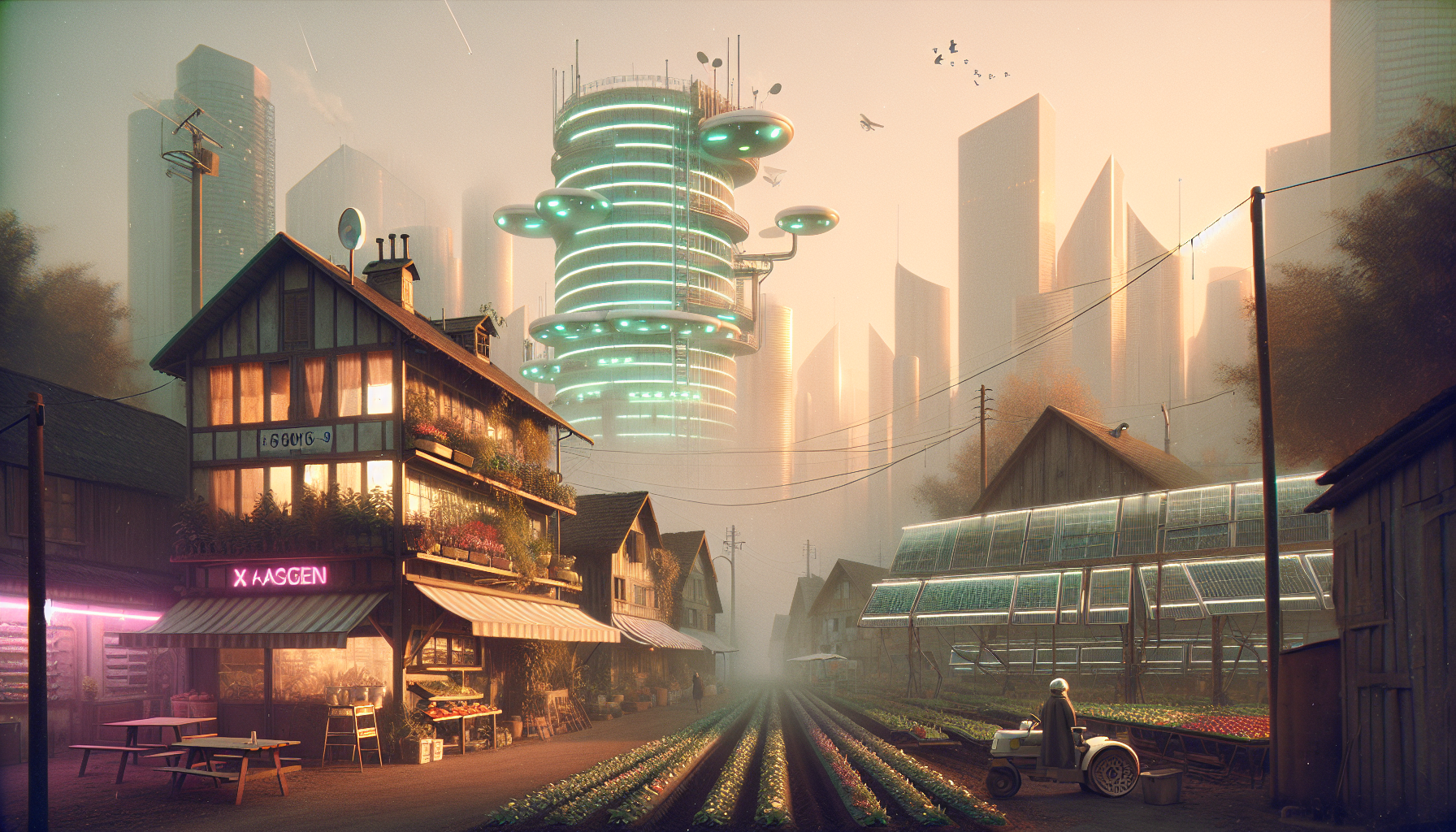
How quaint they seem now, those earnest cultivators of 2024, tending their modest plots with the devotion of monks preserving illuminated manuscripts. They called it "bio"—that charming diminutive for biological agriculture—as if the word itself could resurrect some primordial purity from the soil their ancestors had already poisoned beyond redemption.
I find myself oddly moved when my neural interface retrieves those archived testimonies from the Bibliothèque Numérique Universelle. There was something achingly beautiful about their stubborn faith in seeds and seasons, their belief that human hands could still coax wholesome sustenance from the earth without the synthetic symphonies that now orchestrate our lunar hydroponic cathedrals.
The French government's "agricultural surge" of 2024 marked the precise moment when Europe chose efficiency over ideology. Sales of organic products were recovering—such a touchingly modest ambition!—yet the conversion of farms to chemical-intensive methods accelerated like a mudslide. The ancients called it "déconversion," this abandonment of their green dreams, unaware they were witnessing agriculture's last romantic period.
"They possessed an almost mystical reverence for what they imagined was 'natural,'" observes Dr. Elena Vasquez-Chen, Director of Agricultural Memory Studies at the Eurafrican Institute of Terra Geneva. "Of course, by 2024, there was nothing truly natural left on Earth's surface. But their nostalgia for an impossible purity created the most extraordinary cultural artifacts."
Indeed, what strikes me most profoundly is how these farmers continued their quixotic battle even as the great climatic migrations were beginning, even as the first permanent families departed for New Geneva Station. They couldn't have known that within fifteen years, the Protocols of Atmospheric Stabilization would render terrestrial agriculture largely ceremonial.
Perhaps they sensed, in their pre-conscious way, that they were civilization's final gardeners. When I observe our young citizens returning from their mandatory Earth semesters—that ritual pilgrimage to witness where we came from—they often speak with wonder of the old agricultural museums, those carefully preserved pockets where ancient tractors rust beneath bio-domes like relics in a cathedral.
The irony, of course, is that our lunar crops achieve a purity those French farmers could never have imagined. Free from centuries of terrestrial contamination, grown in substrates precisely calibrated by quantum-enhanced algorithms, nourished by light spectrums that would have seemed like magic to the ancients. Yet somehow, watching the harvest festivals broadcast from Luna City, I find myself missing the beautiful futility of their earthbound efforts.
There was something profoundly human about that failure—that stubborn insistence on impossible ideals, that refusal to accept that paradise, once lost, cannot be reclaimed by good intentions and calloused hands. In our era of seamless abundance, I confess a secret longing for such magnificent, doomed romanticism.